~17%
Of each shift estimated to go back to nurses, away from charting
Role
UX Design Intern
Timeline
Mar – Oct 2025
Tools
Figma
Team
engineer
product manager
ux content writer


Nurses bounce between patients and get interrupted all the time. Most notes end up scribbled on paper.
Charting happens later in the shift. Anything that didn’t make it onto paper comes from memory, and things slip.
That’s a problem because the chart is the patient’s official record. Billing and compliance rely on it.
A typical workflow for nurses looks like this.
After talking to nurses, a simpler workflow would look like this.
The goal was simple: reduce cognitive load during documentation.
Through interviews with University of Michigan nurses, I explored how AI could support patient care workflows.
I tested prototypes quickly and refined each iteration based on how nurses actually worked.
Captured conversations during care and the AI would parse through the information.
Nurses reviewed generated summaries before anything was committed to the EHR.
“It helped with typing, but I still had to figure out what needed to be charted.”
“I was still relying on memory. The transcription didn’t help with that part.”
Typing wasn’t the core problem. Memory and recall were.
I explored a guided conversational interface that prompted nurses through documentation.
The assistant provided contextual awareness while keeping nurses in the loop.
“I need to choose which patient I’m charting for. I can’t trust the AI to figure that out.”
“I need to know what’s an AI suggestion and what’s going in the official record.”
Trust meant predictability and control. This shaped the final iteration.
The final direction introduced explicit patient selection and clearer separation between AI suggestions and confirmed records.
“Finally knowing exactly which patient I’m documenting for makes this feel trustworthy.”
Giving nurses visibility and control over every step made the workflow feel safe enough to integrate into clinical environments.
After selecting a patient, nurses can review, edit, and confirm notes before sending them to the EHR.
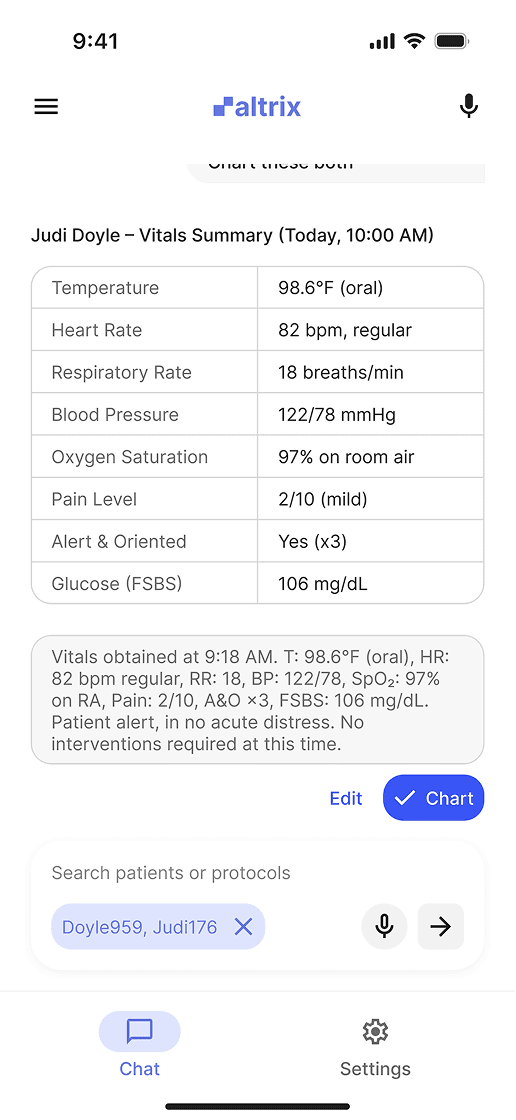
Final in-app experience
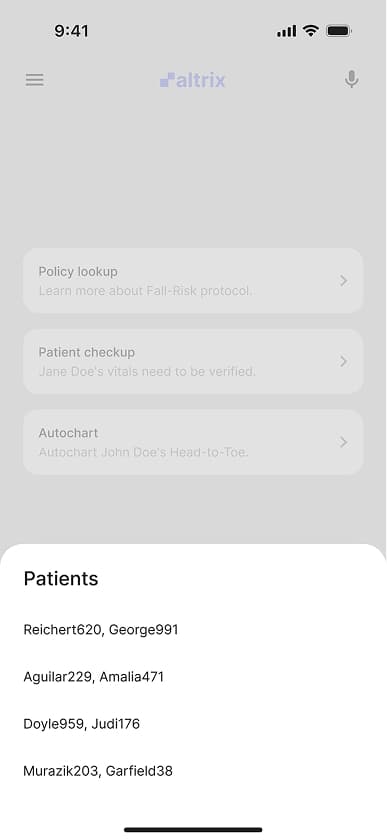
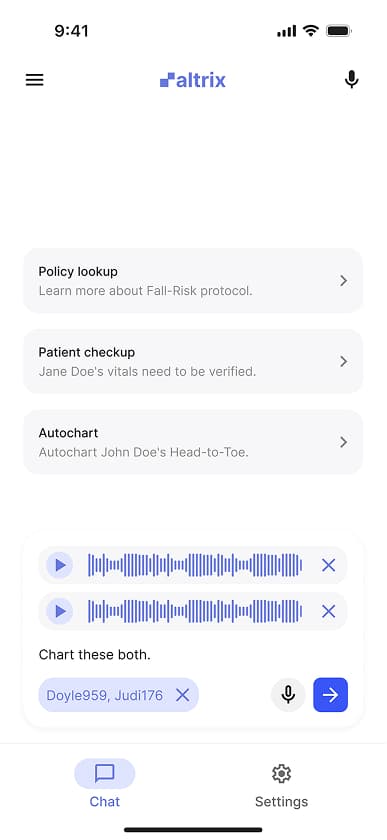
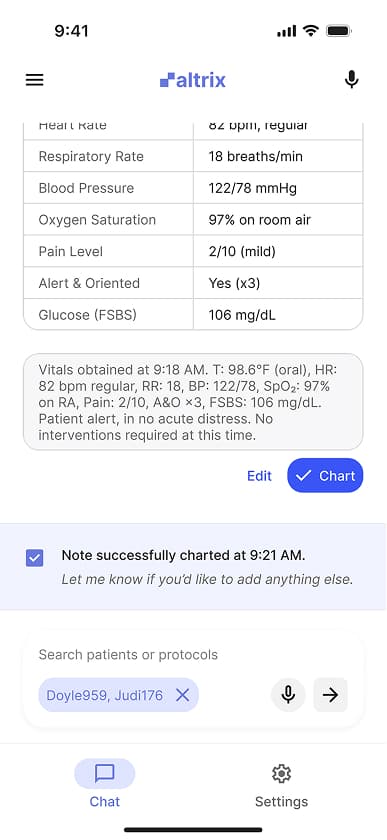
AI suggests. Nurses decide.
Nothing reaches the EHR without explicit confirmation.
The final design reduced documentation friction and preserved the oversight required in healthcare.
Of each shift estimated to go back to nurses, away from charting
Pre-seed funding secured after acceptance into Techstars
Hospitals involved in pilot discussions through HCA Health’s network